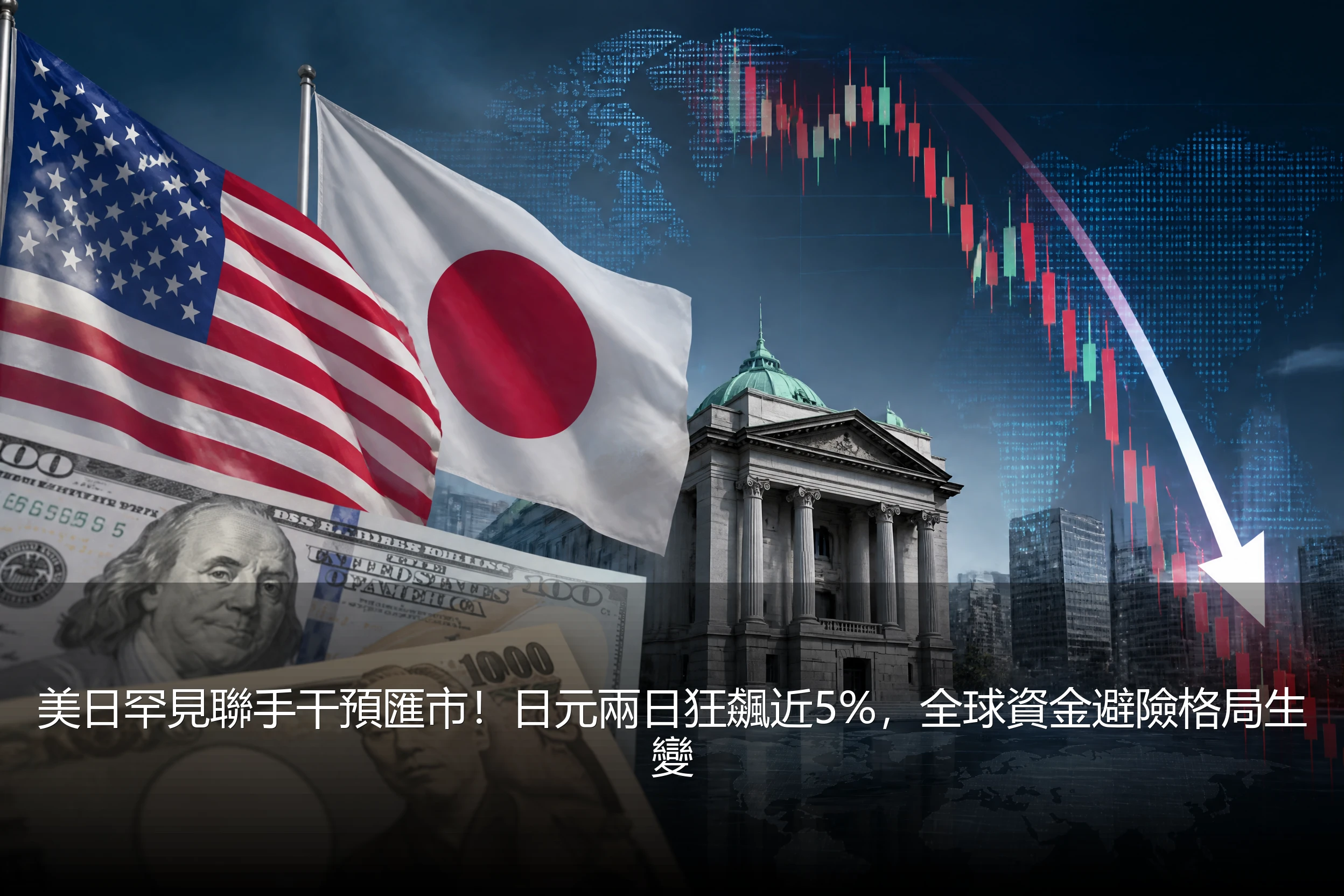
In early August 2026, the global foreign exchange market witnessed a rare event: the United States and Japan, the two largest economies, rarely joined hands to directly intervene in the yen exchange rate. This is the first time since 2011 that the United States has actually used funds to support the yen, and it is the first time in many years that the two countries have taken joint action. As soon as the news came out, the yen exchange rate surged by nearly 5% in two days, returning to the strong area of 1 US dollar to 156 yen, and the flow of global capital and the logic of safe-haven have changed, casting a shocking bomb on the international foreign exchange market in the second half of the year.
Intervention Details: The Largest Single-Day Action in History
Let's go back to the New York trading session on July 30. The US dollar to yen once surged above 162.8, reaching a rare weak level in 40 years. However, in the next short hour, the yen rose sharply, returning to near 158, with a single-day maximum increase of 3.3%, setting the largest single-day increase since December 2023. Such a fast and concentrated price movement, without major economic data as a direct trigger factor, the market generally judged that the Japanese Ministry of Finance had directly entered the market to buy yen.
According to the Bank of Japan's account data and market institution estimates, the scale of Japan's yen purchases on that day may have reached as high as 8.45 trillion yen, equivalent to 52.8 billion US dollars. If officially confirmed, this will become the largest single-day foreign exchange intervention in Japanese history. However, the effect of the first round of intervention did not fully continue. As some investors re-established short positions, the US dollar to yen once returned to near 161. On July 31, Japan entered the market for the second consecutive day, and this time, the United States also joined the fray—the US Treasury first conducted exchange rate inquiries through the New York Fed, and then actually entered the market to buy yen, forming a joint US-Japan intervention. Under the joint push of the two countries' policy forces and short covering, the US dollar to yen fell by 1.29% on the day, closing at 157.49.
US Entry: Signal Significance Far Exceeds Capital Scale
Different from Japan's many unilateral interventions in the past, the United States' upgrade from 'verbal support' to 'real money' direct transactions is the most shocking change in this round of action. On the evening of August 2, US Treasury Secretary Bessant posted on social media that the coordinated foreign exchange intervention by the US and Japan 'effectively curbed the disorderly fluctuation of the yen exchange rate', the Trump government strongly supports Japan's measures to correct the significant undervaluation of the yen, and emphasized that the US Treasury is closely monitoring the situation and will 'without hesitation participate in further joint interventions'.
Japanese Finance Minister Satsuki Katayama also confirmed on August 3 that the US and Japan jointly implemented the purchase of yen on July 31, in accordance with the joint statement of the US and Japanese finance ministers issued in September 2025. She said that Japan will continue to maintain close communication with the US Treasury and will take further actions without hesitation if necessary. Market people pointed out that the New York Fed actually executing the purchase of yen transactions means that shorting the yen is no longer facing only the Japanese Ministry of Finance, but the joint force of the financial departments of the two countries, which significantly increases the deterrent to speculative short positions and yen carry trades.
Behind the Intervention: Dual Calculations of Stabilizing the Yen and Safeguarding US Treasuries
The direct reason for Japan's action is that the continuous depreciation of the yen has pushed up the costs of energy, food and other imports, weakening the actual purchasing power of residents, and putting the Bank of Japan in a dilemma of rising imported inflation and economic growth pressure. The motivation for US participation is more complicated. Japan is one of the largest overseas holders of US Treasuries, holding about 1.14 trillion US dollars of US Treasuries as of May this year; Japan's intervention requires the use of foreign exchange reserves in US dollars. If the scale continues to expand, it may trigger Japan to sell US Treasuries, further pushing up long-term US interest rates—since the beginning of this year, the 10-year US Treasury yield has risen by about 57 basis points, and the long-term financing cost of the US government continues to be under pressure.
In order to avoid Japan selling US Treasuries in the market to raise intervention funds, the US specially used the Foreign and International Monetary Authorities Repurchase (FIMA) tool. Through this mechanism, Japan can temporarily mortgage its US Treasuries to the Fed in exchange for US dollar funds, then sell US dollars and buy yen, obtaining the funds needed for intervention without directly selling US Treasuries in the market. Bessant bluntly stated that the FIMA repurchase tool is an 'important backup mechanism' and advocated expanding its scale in the coming months. From an operational perspective, the US-Japan action takes into account both exchange rate and bond market stability—on the one hand, directly buying yen to curb disorderly depreciation, and on the other hand, using the FIMA mechanism to reduce the impact of intervention on the US Treasury market.
Policy Follow-up: Bank of Japan's September Interest Rate Hike Expectations Rise
The intervention has bought precious time for Japan and has also shifted market focus to monetary policy. Bessant publicly urged Japan to follow up with fundamental measures such as interest rate hikes, emphasizing that 'intervention must be supplemented with interest rate hikes', otherwise the market will worry about the Bank of Japan's slow action in fighting inflation. He revealed that he will hold a bilateral meeting with Bank of Japan Governor Kazuo Ueda at the G20 finance and central bank leaders' meeting to be held in the United States at the end of August, which is widely interpreted as paving the way for a September interest rate hike.
The minutes of the Bank of Japan's June meeting showed that members unanimously agreed that continuing to raise interest rates was appropriate, and most members warned of the risk that core inflation may exceed the 2% target. Currently, the Bank of Japan's benchmark interest rate is maintained at 1%, and market expectations for a rate hike at the September 17-18 policy meeting continue to rise. A Reuters survey shows that most analysts expect the Bank of Japan to raise interest rates again before December, possibly as early as October; but there are also views that under US pressure, the possibility of a September interest rate hike cannot be underestimated.
Expert Perspective: Intervention Difficult to Change Structural Weakness
Although the short-term effect is significant, analysts generally believe that foreign exchange intervention can change the rhythm of exchange rate movements, but not the long-term direction determined by economic fundamentals. Kazuo Momma, executive economist at Mizuho Research Institute and former Bank of Japan official, bluntly stated that intervention is a 'buying time strategy', and if not followed by interest rate hikes by the Bank of Japan, it may be in vain in the end. The root of the yen's long-term weakness still lies in structural factors such as the US-Japan interest rate differential, low domestic real interest rates, rising energy import costs, and Japanese institutions continuing to allocate overseas assets.
Vishnu Varathan, Asia-Pacific macro strategy director at Mizuho Securities, said that only when the intervention direction is consistent with monetary policy, interest rate changes, and dollar trends, can the effect be lasting. From historical experience, this round of joint action is more likely to define a phased policy defense line for the yen, rather than directly confirming a long-term appreciation turning point. Whether the yen can continue to strengthen in the future still depends on the pace of the Bank of Japan's interest rate hikes, the Fed's policy direction, global energy price trends, and whether Japanese capital reduces overseas asset allocation.
Implications for Investors
For global investors, the joint US-Japan intervention sends multiple signals, and asset allocation logic needs to be adjusted accordingly:
- The tolerance of major economies for 'disorderly fluctuations' in exchange rates is decreasing, and a policy defense line for the yen exchange rate has taken shape, with the previous low point possibly having certain support.
- The risk of yen carry trades has risen sharply, and the strategy of financing with low-interest yen and investing in high-yield assets is facing repricing, and related volatility may spill over to global risk assets.
- If Japan launches a new round of interest rate hikes, it will deeply affect global capital flows, and Japanese stocks, Japanese bonds, and Asian currencies may all undergo structural changes, further increasing the importance of exchange rate risk management.
In a policy-changing environment, investors should closely follow the follow-up developments of the September Bank of Japan meeting and the G20 finance and central bank meeting, while reviewing the yen and Japanese asset exposures in their investment portfolios, and timely adjust the exchange rate risk exposure in global allocation to seize opportunities in the increasingly volatile market.