
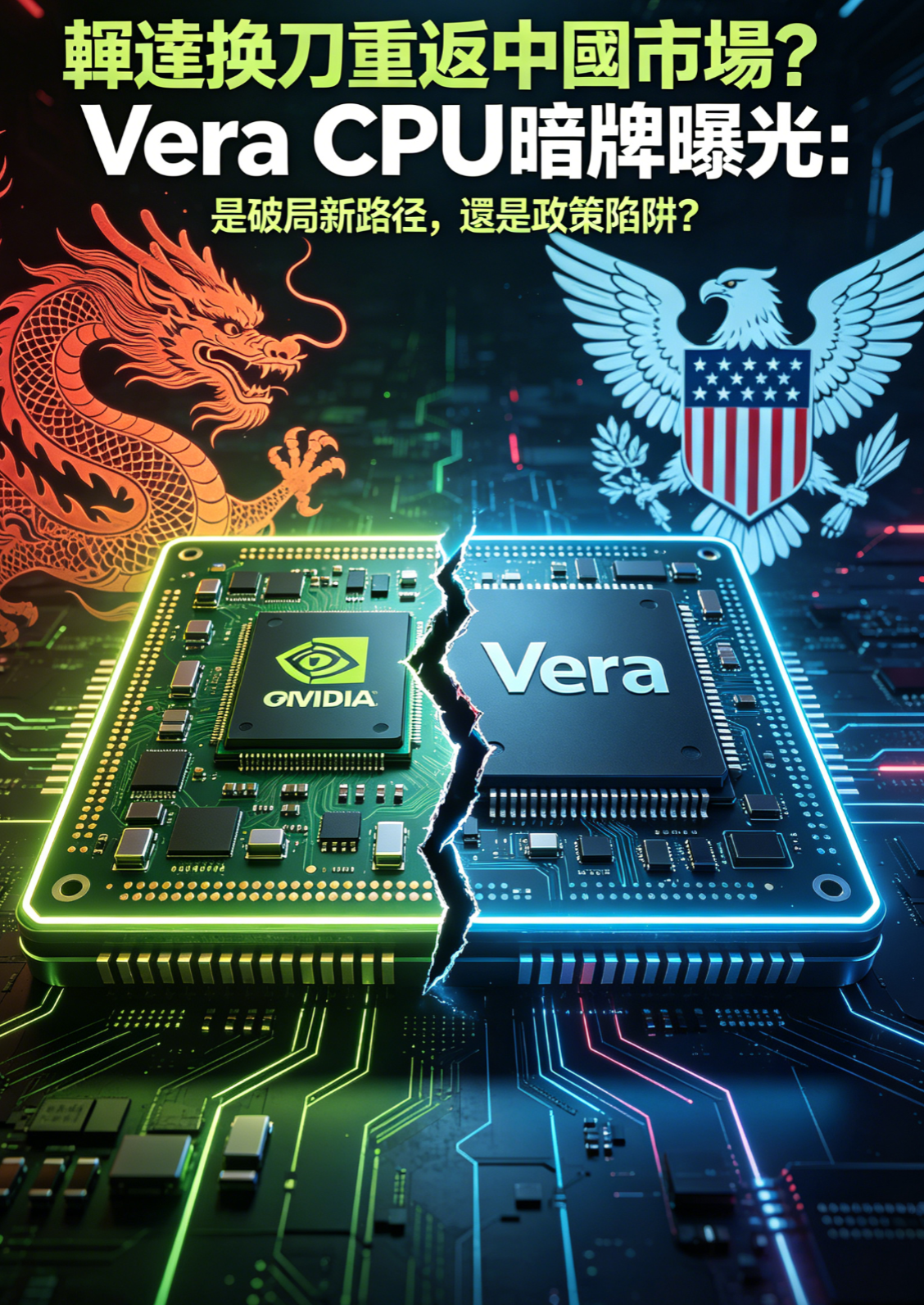
NVIDIA is not relying on high-end GPUs to attack the Chinese market this time; instead, it has swapped to a more covert new weapon—the Vera CPU. Due to US export controls, high-end GPU promotion in China has been hindered, and H200 chips have never been able to be deployed in large scale. However, Reuters has released a key signal: NVIDIA has officially started pitching the Vera CPU to Chinese customers, with supply expected to begin as early as August this year. Some major Chinese cloud service providers have already planned to purchase over 300 servers for initial testing.
Unlike general-purpose civilian CPUs, Vera CPU is a professional-grade core chip designed by NVIDIA specifically for AI agents, inference computing, and data center orchestration. This move has sparked core market debate: Is NVIDIA bypassing GPU controls through CPUs to reopen the Chinese AI market? Or will it face dual constraints from policy regulation and domestic substitution again? This article comprehensively dissects this event, analyzing its deep impact on NVDA stock price, AI supply chain, and retail investors.
Core Conclusion First: Strategic Value Far Outweighs Short-Term Earnings Boost
The landing of Vera CPU in the Chinese market is a highly intelligent marginal positive move and strategic layout for NVIDIA, but not a heavy catalyst that can drive a stock price revaluation.
Currently, the overall progress is only at the stage of business promotion, intent orders, and field testing. No large-scale shipment orders have been confirmed. Even if supply starts in August as scheduled, it does not mean NVIDIA will generate tens of billions of dollars in incremental revenue in the short term. The most common mistake in the investment market is equating "market possibility" directly with "actual earnings," or "small-batch testing" directly with "explosive orders." Wall Street is good at telling industry stories, but the market will ultimately be tested by real financial report data.
Although the short-term earnings contribution is limited, the long-term strategic significance is extremely profound. In the past, NVIDIA's biggest pain point in the Chinese market was the strict restriction of high-end GPUs by US export controls, trapped in the triple embarrassment of "customer demand, policy restrictions, and local substitutes," like holding a hot soup, unable to land smoothly.
Core Positioning of Vera CPU: Not Replacing GPU, but Commanding the AI Computing System
Many investors have a cognitive misunderstanding, believing that only GPU is core to an AI data center. In reality, GPUs handle heavy workloads like matrix operations and model training; they are the "core workers" of AI compute. But as AI scenarios evolve to the agent era, a large number of task scheduling, data preprocessing, instruction distribution, tool invocation, and network communication steps require high-performance CPU support.
Simple analogy: GPU is the high-fire chef in the kitchen, responsible for core cooking; Vera CPU is the overall manager in the back office, coordinating all processes, allocating tasks, and optimizing tempo. If the back office scheduling is inefficient, even the strongest chef can only idle, severely constraining the overall AI system performance.
According to NVIDIA's official data, Vera CPU achieves 2x overall computing efficiency improvement and 50% faster operation compared to traditional server CPUs. Its core value is not to replace GPU, but to optimize the operational logic of the entire AI factory, maximizing GPU compute release.
This is also NVIDIA's core layout thinking: not simply selling single GPU chips, but building a complete AI infrastructure system of "CPU scheduling + GPU computing + network transmission + software ecosystem." Once customers fully adopt the entire architecture, the cost of switching suppliers is extremely high, creating a solid moat and customer stickiness.
NVDA Stock Current Situation: Severe Test Under Giant High Valuation
Currently, NVIDIA is priced at around $205, with a market cap approaching $5 trillion. It has long left the category of ordinary growth stocks and become the "weather vane" of US tech stocks. Its price movement affects the entire semiconductor, AI, and cloud computing supply chain, and the market's valuation standards are far beyond general companies.
NVIDIA's latest financial report remains impressive: quarterly revenue of $81.6 billion, up 85% YoY; data center revenue of $75.2 billion, up 92% YoY; gross margin maintained at a super-high 75%. These figures are top-tier for any company. But for NVIDIA, the market only asks three questions: Can profits sustain high growth? Can the Chinese market return to incremental growth? Can new businesses open a second growth curve?
The harsh rule for high-valuation companies is: ordinary good news cannot push the stock up, but slight negative news is easily magnified by the market. At present, NVIDIA's price game is not just about industry competition; it must also face macro environment pressure.
Macro level: US May CPI rebounded to 4.2% YoY, core CPI at 2.9%, inflation pressure rising again. The new Fed chair chaired the first FOMC meeting; although the market expects rates to stay unchanged, the policy tone will directly affect high-valuation tech stocks. The 10-year Treasury yield remains at 4.5%, forming a ceiling over tech stocks—when risk-free returns are stable enough, the market's vision premium for high-valuation growth stocks will shrink significantly.
Short-term market sentiment has eased slightly, with the dollar index falling and VIX cooling, but this does not mean risk is gone. In this context, Vera CPU's Chinese market layout becomes a key card for NVIDIA to stabilize market expectations, sending a clear signal: faced with GPU control restrictions, NVIDIA is not passively waiting, but actively expanding product boundaries, upgrading from single chip sales to overall AI base solution output.
Three Core Values of Vera CPU Layout
1. Market Increment: Capturing China's Rigid AI Demand
China's large model, cloud computing, and enterprise AI inference market demand is real and sustained; it will not disappear due to controls or domestic substitution. Even as local chip industries rise rapidly, companies will still prioritize product performance, ecosystem completeness, deployment efficiency, and total cost. Test introduction does not equal large-scale procurement, but it proves that China's rigid demand for NVIDIA's new technology still exists.
2. Product Expansion: Breaking Single GPU Revenue Dependency
For a long time, NVIDIA's revenue has been heavily dependent on GPU products. The landing of Vera CPU marks NVIDIA officially entering the server CPU track, filling the core chip puzzle of AI data center, and optimizing the overall revenue structure. As Jensen Huang has said, the CPU market is a trillion-level incremental market and a key direction for NVIDIA to break growth ceiling.
3. Ecosystem Binding: Strengthening Long-Term Customer Stickiness
Even if Chinese cloud vendors first test Vera CPU in overseas data centers, they will complete software tool chain and system architecture adaptation and integration in advance. Once the ecosystem matures, if the regulatory environment eases or enterprise overseas business expands, NVIDIA can quickly achieve scaled deployment, locking long-term cooperation space ahead of time.
Four Cognitive Pitfalls Investors Must Avoid
Pitfall 1: Treating CPU Testing as Full Market Unlock in China
Currently, CPU regulatory resistance is only relatively lower than high-end GPU. The US AI chip export control framework has not loosened; the industry regulatory boundary remains strict, and full opening does not exist.
Pitfall 2: Equating Small-Batch Testing with Large Order Landing
300 servers of testing carry industry signal significance, but for NVIDIA's quarterly revenue of $81.6 billion, the short-term financial impact is negligible; it cannot change overall earnings trajectory.
Pitfall 3: Underestimating CPU's Industry Strategic Value
GPU is the "star player" on the AI stage, while CPU is the "behind-the-scenes core" running throughout. In the agent AI era, the importance of scheduling and inference continues to rise; locking the CPU market means locking long-term AI infrastructure discourse power.
Pitfall 4: Focusing Only on NVIDIA, Ignoring the Entire Chain Rotation
The landing of Vera CPU will drive demand across the entire chain: server ODM, liquid cooling, network communication, memory, advanced packaging, data center construction, etc. At the same time, NVIDIA's cross-border entry into the CPU track will directly rival AMD EPYC and Intel Xeon, reshaping the global server CPU competitive landscape.
Five Key Signals to Monitor
1. August Supply Progress: Whether mass supply starts on schedule is the core indicator to distinguish "story expectation" from "real landing." If stalled, market heat will quickly fade.
2. Core Customer List: Confirm the cloud vendors participating in testing, order scale, and cooperation model to avoid excessive market expectations.
3. Deployment Field Attributes: If testing equipment is deployed in overseas data centers, it means demand is real but domestic regulation remains strict; key to judging market opening pace.
4. US Policy Stance: AI hardware controls have uncertainty; although CPU is not strictly restricted in the short term, subsequent rule tightening cannot be ruled out.
5. Official Financial Report Verification: Monitor NVIDIA's next quarterly report and conference call to see if it actively mentions Vera CPU orders, capacity, and revenue contribution, confirming whether it is incorporated into the core growth narrative.
Investment Opportunities, Risks, and Practical Strategies
I. Core Investment Opportunities
NVIDIA (NVDA): Long-term still the AI infrastructure leader. Vera CPU strengthens its systematic competitive advantage. But under a $5 trillion market cap, earnings realization is extremely difficult; suitable for gradual position building, avoid chasing highs.
AI Server and Data Center Supply Chain: Compared to NVIDIA itself, upstream and downstream supply chains have greater earnings elasticity. Focus on targets with confirmed orders and stable profitability.
Global CPU Track: NVIDIA's entry will restart server CPU competition. Traditional leaders like AMD and Intel will face valuation re-rating opportunities. Competition upgrades from pure computing power duel to "CPU + GPU + Software Ecosystem" system confrontation.
II. Five Risks Not to Ignore
1. Policy Risk: US-China tech friction persists; AI hardware control boundaries adjust dynamically; CPU is not an absolutely safe track.
2. Order Fulfillment Risk: Test intentions do not mean actual revenue; after excessive market expectations, profit-taking may occur.
3. Ecosystem Switching Risk: Chinese enterprises have heavily invested in domestic chips and software ecosystems; switching suppliers involves high time and financial costs, creating resistance to large-scale substitution.
4. Valuation Pressure Risk: NVIDIA's high valuation has already priced in most good news; if Treasury yields rise or liquidity tightens, stock price faces adjustment pressure.
5. Market Crowding Risk: NVDA is a globally concentrated allocation target; when sentiment reverses, it may suffer stampede-like declines with high volatility.
III. Practical Strategy for Retail Investors
Existing Position Holders: No need to blindly add or sell on single news; treat Vera CPU as a long-term observation indicator, and base holdings on financial report performance.
Those Not Yet Positioned: Avoid emotional chasing; wait for triple confirmation: news landing, stock price pullback, and earnings verification. Do not buy at peak expectations.
Diversified Allocators: Consider moderately allocating to semiconductor ETFs, AI infrastructure, servers, network communication, etc., to avoid the volatility risk of single-stock NVDA.