


 <\/div><\/div>
Japan Government Bond Yields Rise: Technical Analysis and Market Drivers<\/h1>\nSummary<\/h2>\n
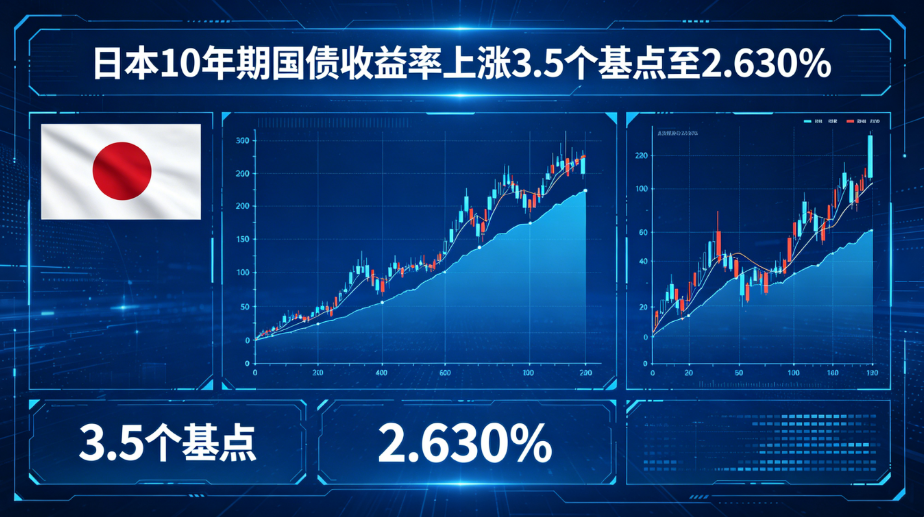
In May 2025, Japan's 10-year government bond yield rose 3.5 basis points to 2.630%. This change not only reflects the linkage of the global interest rate environment but also marks a substantial advancement in the Bank of Japan (BOJ) normalization path of ultra-loose monetary policy. This article analyzes the logic behind this interest rate increase from a technical perspective, including yield curve dynamics, inflation expectations, foreign arbitrage behavior, and central bank balance sheet management, and assesses its potential impact on Japan's financial system and the global bond market.<\/p>\n
Keywords<\/h2>\n
Japan Government Bonds, Yield Curve Control, Monetary Policy Normalization, Inflation Expectations, Foreign Arbitrage<\/p>\n
\n
1. Introduction: Structural Implications of Interest Rate Changes<\/h2>\n
Japan's 10-year government bond (JGB) yield rose 3.5 basis points to 2.630% in a single day in May 2025. Though it seems modest, it is a landmark event in an environment of prolonged low interest rates and even negative rates. Looking back at the gradual relaxation of Yield Curve Control (YCC) by the BOJ since 2022, JGB yields have climbed from below 0.1% and are now above the upper end of the range forecast by many analysts at the beginning of the year.<\/p>\n
This rise is not an isolated event but the result of multiple technical factors and macroeconomic expectations. First, after the March meeting, the BOJ explicitly adjusted its bond purchase operations, reducing artificial suppression of long-end rates. Second, against the backdrop of delayed expectations for a US Federal Reserve rate cut and oil price volatility, the global bond market faces "rate reset" pressures. Finally, although Japan's domestic inflation has receded, it remains above the target, and markets are pricing in the possibility of another rate hike by the BOJ before 2026.<\/p>\n
This article examines the market consensus and potential risks represented by the 2.630% level from four dimensions: technical trading structure, central bank balance sheet management, expectation path, and cross-asset linkages.<\/p>\n
2. Yield Curve Dynamics: Flattening or Steepening?<\/h2>\n
The shape of the yield curve is a key indicator for judging monetary policy expectations. As of mid-May, the spread between Japan's 2-year and 10-year yields was about 45 basis points, significantly wider than the 30 basis points at the start of the year, showing a "bull steepening" pattern. Specifically:<\/p>\n
- \n
- Short-end rates (2-year)<\/strong> are most affected by the BOJ policy rate, currently in the 0.25%-0.50% range. The market-implied rate hike path pushes short-end yields higher, but at a slower pace as the market is still digesting the "no change" signal from the April meeting.<\/li>\n
- Long-end rates (10-year)<\/strong> reflect longer-term inflation premiums and term premiums. A yield of 2.630% implies that the market expects the average real interest rate plus inflation compensation over the next decade to be around 2.6%, well above the BOJ's 2% inflation target, suggesting the market does not believe inflation will quickly fall below the target.<\/li>\n<\/ul>\n
From a technical perspective, 2.630% is exactly below the key resistance level of the previous high from October 2023 (around 2.650%). If this level is effectively broken, the next target would be the psychological level of 3.0%, which has not been seen since 2011. Currently, the negative correlation between the yen exchange rate and JGB yields is significant: rising yields lead to yen appreciation, further suppressing import inflation, forming an endogenous stabilization mechanism.<\/p>\n
3. Central Bank Balance Sheet and Bond Purchase Operations: Technical Details of YCC Exit<\/h2>\n
Since abandoning the formal YCC target in March 2024, the BOJ has adopted a "flexible bond purchase" model, but still sets daily purchase amounts and guides rates through regular operations. The direct trigger for the yield rise in May was the BOJ's reduction of its purchase amount for JGBs with maturities of 10 years and above from 500 billion yen to 400 billion yen in its regular bond purchase operation on May 9, a decrease of 20%.<\/p>\n
This move sends a strong policy signal: the BOJ is gradually reducing artificial suppression of long-end yields, allowing market supply and demand to play a greater role. From a balance sheet technical perspective:<\/p>\n
- \n
- The BOJ currently holds over 50% of JGBs, with net purchases still around 4-5 trillion yen per month. However, as inflation expectations heat up, the Ministry of Finance is also increasing bond issuance (planned issuance of about 170 trillion yen in fiscal 2025), and supply pressures are beginning to emerge.<\/li>\n
- Foreign holdings of JGBs account for about 13%, and in a rising yield cycle, foreign investors' willingness to reduce holdings strengthens. According to Japan's Ministry of Finance data, foreign investors net sold about 2.3 trillion yen in JGBs in April, the highest in nearly two years. This wave of foreign selling may accelerate after the technical breakout in yields.<\/li>\n<\/ul>\n
In addition, Japan's interbank market liquidity indicators (such as repo rates) saw a temporary spike in May, indicating that the scarcity of government bond collateral has eased somewhat, further confirming the shift in supply-demand structure.<\/p>\n
4. Inflation Expectations and Real Interest Rates: Testing the Reasonableness of 2.630%<\/h2>\n
An important tool for measuring market inflation expectations is the breakeven inflation rate (BEI). Currently, Japan's 10-year BEI is about 1.8%, above the BOJ's 2% target but below the current CPI (about 3.2%). This implies that the market expects medium- to long-term inflation to return to around 2%, but with short-term upside risks. Using this BEI, the real interest rate corresponding to the 2.630% nominal yield is about 0.83%, the first time it has turned positive since 2016.<\/p>\n
A positive real interest rate has far-reaching implications for the Japanese economy:<\/p>\n
- \n
- Household savings behavior: In the era of negative real rates, deposit purchasing power was continuously eroded; after turning positive, savings become more attractive, potentially dampening consumption and real estate investment.<\/li>\n
- Corporate financing costs: Japanese companies have long relied on low-rate financing. A rise in real rates will compress profit margins, especially affecting small and medium-sized enterprises and long-term public infrastructure projects.<\/li>\n
- Insurance and pensions: Life insurance companies hold large amounts of ultra-long JGBs. Rising yields help improve the matching of liability costs and asset returns, but short-term market value losses may trigger accounting impairments.<\/li>\n<\/ul>\n
From a cross-country comparison, Japan's 10-year yield is still well below the US (about 4.5%) and Germany (about 2.8%), but the narrowing trend is evident. If Japan's yield continues to rise to 3%, it will approach German bonds, attracting global carry trade funds back into yen assets.<\/p>\n
5. Global Market Linkages and Spillover Effects<\/h2>\n
As the world's third-largest economy and largest creditor nation, Japan's interest rate changes affect global markets through multiple channels:<\/p>\n
- \n
- Cross-market arbitrage<\/strong>: The US-Japan interest rate spread has narrowed from 4 percentage points to 1.9 percentage points, reducing the attractiveness of yen carry trades. When the yen appreciates alongside rising JGB yields, funds may flow back to Japan from emerging markets, causing emerging market bond yields to rise in tandem.<\/li>\n
- Safe-haven attribute<\/strong>: JGBs have long been considered safe assets. Sharp yield fluctuations may trigger risk aversion, causing US and German bond yields to follow temporarily, but could diverge in the medium to long term.<\/li>\n
- Stock market impact<\/strong>: The Japanese stock market (Nikkei 225) shows an inverted U-shaped relationship with yields: a moderate rise reflects economic improvement, but a rapid uptick (such as after breaking 2.630%) could pressure valuations, especially in highly leveraged utility and real estate sectors. On May 10, the Nikkei fell 1.2%, initially showing market sensitivity to rate changes.<\/li>\n<\/ol>\n
6. Conclusion: A Critical Turning Point for Policy?<\/h2>\n
A yield of 2.630% is not just a number, but a market vote on the pace of BOJ monetary policy normalization. From a technical analysis perspective, if this level can hold, it will reinforce bullish confidence and guide yields toward 3%; if it faces central bank intervention or a weakening of macroeconomic data, it may test support at 2.4%.<\/p>\n
For investors, the key is to monitor the BOJ's June meeting bond purchase plan adjustments, the inflation forecast in the July economic outlook report, and the asset allocation moves of the Government Pension Investment Fund (GPIF). If the GPIF increases ultra-long JGB allocations, it will provide buy-side support; conversely, continued foreign outflows will accelerate the rate rise.<\/p>\n
Ultimately, Japan's interest rate normalization path is neither linear nor has a template to follow. 2.630% may be just a waypoint, but it has clearly revealed that the last bastion of "artificially low rates" in the global economy is crumbling. Market participants must recalibrate their risk pricing for Japanese assets and welcome a new era of normalization with increased volatility.<\/p>

- Safe-haven attribute<\/strong>: JGBs have long been considered safe assets. Sharp yield fluctuations may trigger risk aversion, causing US and German bond yields to follow temporarily, but could diverge in the medium to long term.<\/li>\n
- Cross-market arbitrage<\/strong>: The US-Japan interest rate spread has narrowed from 4 percentage points to 1.9 percentage points, reducing the attractiveness of yen carry trades. When the yen appreciates alongside rising JGB yields, funds may flow back to Japan from emerging markets, causing emerging market bond yields to rise in tandem.<\/li>\n
- Long-end rates (10-year)<\/strong> reflect longer-term inflation premiums and term premiums. A yield of 2.630% implies that the market expects the average real interest rate plus inflation compensation over the next decade to be around 2.6%, well above the BOJ's 2% inflation target, suggesting the market does not believe inflation will quickly fall below the target.<\/li>\n<\/ul>\n

